

2023-12-19
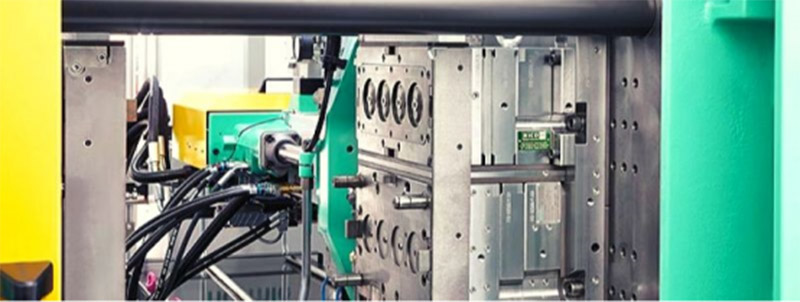
Nowadays, various mature injection molding processes bring more creative space to designers and engineers. They can inspire their inspiration to enhance the appearance and ergonomics of the product.
Often a single material or color does not meet the manufacturing requirements of the product. The materials for these products range from plastics to metals.
In the past, this was done by using additional secondary services or more complex assemblies to create finished products. However, today’s multi-material injection molding largely eliminates these additional requirements, making it easier to manufacture complex finished products, faster, and cheaper.
What is multi-material injection molding?
It is a single component made from a combination of two or more plastic or elastomeric materials. You can read the definition in Wikipedia. Before that, I thought this was a category of overmolding.
I think overmolding is a big category. Only some parts are similar to multi-material injection molding or insert molding, so the overmolded part is classified into multi-material injection molding.
In fact, I also found different voices, but I prefer authority. Then I divide the multi-material injection molding into:
1.Multi-component injection molding
2.Multi-shot injection molding (MSM)
3.Over-molding
Multi-shot injection molding (MSM)
Also referred to as sequential injection molding, multi-shot injection molding refers to creation of multiple layers relative to the starting axis of the initial mold. In other words, the warm, heated materials are inserted into the mold in a very specific sequence one after another.
This creates a layering effect between materials while maintaining relatively high-energy interactions at material boundaries. This is important because it implies that the inter-layer bonds are stronger in many cases than when the layers are applied to a previously cooled part, as is more closely the case of over molding. While there are other applications, this operation is preferred when varying molds (different geometries) are desired between material layers.
Multi-shot injection molding applications
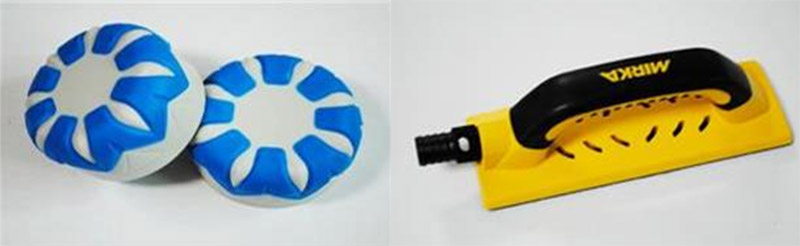
This technology or process is nothing new, and is simply used for the production of two-color plastic parts or products. The two materials form a single plastic part by physical (snap, surface roll, thread) or chemical (co-bonding, miscible) bonding.
In some places, it is called 2k injection molding. 2K injection molding (MSM) is by far the most versatile, complex and interesting of the MMM process. It requires a specific two-color injection molding machine to complete the injection molding. Plastic parts need to be molded twice, but the product is only ejection once, usually by a set of molds.
3 types of mold structure
According to moving different mold parts can be divided into:
1. Rotary Platen Multi-Shot Molding
2.Index Plate Multi-Shot Molding
3.Core Toggle Multi-Shot Molding
Rotary Platen Multi-Shot Molding
Rotary Platen MSM is the simplest and most common category of MSM. The figure below shows a simplified schematic of a rotary platen MSM mold.
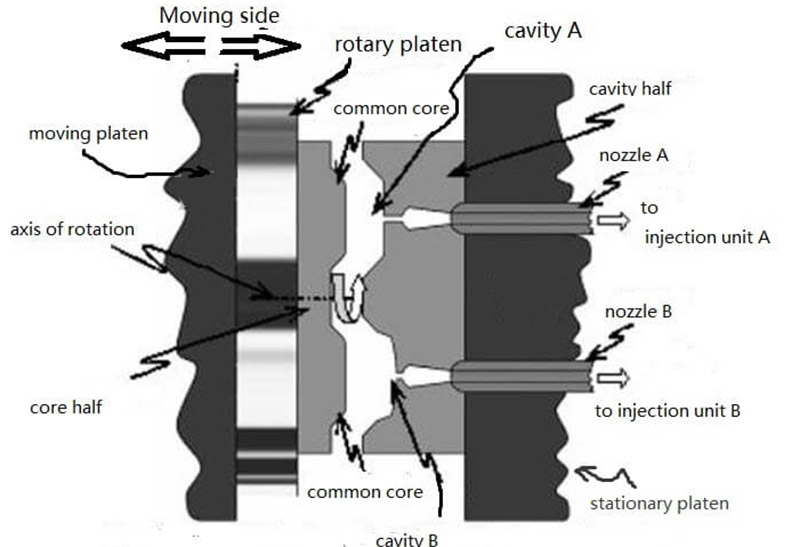
The mold feature is the rotating platen on the left side of the figure. The core plate contains two identical cores that are mirrored on the centerline of the platen and coincide with the axis of rotation. The cavity plate connected to the fixed platen contains two cavities with different geometries. Essentially, in each cycle, the rotating platen completes the switching of the injection molded parts. Eliminates the need for manual switching.
Molding process
The figure is a rotatable platen molding process is described as follows: